
Support patients between visits
Noctua Care integrates into the care gap between appointments by enabling Medicare care management codes


In short
What is the best digital care management solution for cardiology?
Noctua Care is a leading remote patient monitoring provider for cardiology practices. Noctua Care delivers RPM, PCM and CCM. Noctua Care integrates FDA-cleared devices, EHR records, and supports Medicare billing.

Key conditions
Key conditions in cardiology care
Which route a patient falls into is decided by how many conditions they carry and how severe the driving one is.
| Condition | What is monitored | Qualifies for |
|---|---|---|
| Recent myocardial infarctionI21.x | Blood pressure, heart rate, weight, symptom burden | Qualifies for: RPM · PCM |
| Chronic ischemic heart diseaseI25.x | Blood pressure, heart rate, activity | Qualifies for: RPM · CCM |
| Heart failureI50.x | Daily weight, blood pressure, oxygen saturation | Qualifies for: RPM · CCM · PCM at NYHA III–IV |
| Atrial fibrillation and flutterI48.x | Heart rate trend, rate control, anticoagulation | Qualifies for: RPM · CCM |
| Essential hypertensionI10 | Twice-daily blood pressure | Qualifies for: RPM · CCM · PCM if resistant |
| Post-CABG, post-PCIZ95.1 / Z95.5 | Recovery trajectory, blood pressure, weight | Qualifies for: RPM |
RPM needs one condition and no waiting period, so it can start the week of discharge. CCM needs two, expected to last a year. PCM needs one, expected to last three months, severe enough to organize the whole care plan.
The programs
Three programs are available to a cardiology practice
- RPM
Remote Patient Monitoring
Medicare reimbursement for reviewing physiologic data captured by an FDA-cleared connected device and transmitted from the patient's home. The only route that needs a device, and the only one with a monthly transmission threshold.
- Starts immediately after discharge
- One qualifying condition, acute or chronic
- Stacks with CCM or PCM
- Partial-month codes since 2026
- CCM
Chronic Care Management
Medicare reimbursement for non-face-to-face coordination for patients carrying two or more chronic conditions expected to last at least twelve months. No device, no threshold beyond time, which is why most practices launch here first.
- No device — enrollment is immediate
- Most post-MI panels already qualify
- 20 minutes of staff time a month
- Stacks with RPM
- PCM
Principal Care Management
Medicare reimbursement for care management focused on a single high-risk chronic condition. Unlike CCM, which requires two or more, PCM is built for the patient who needs intensive management of one complex condition with frequent medication adjustment and specialist oversight.
- Higher per-patient revenue than base CCM
- Only one qualifying condition needed
- Specialist-focused by design
- Fits NYHA III–IV, resistant hypertension
Reimbursement
The applicable codes, and what each pays
RPMRemote Patient Monitoring
$107–210 per patient, per month
Device and setup
| Code | Service | National average | |
|---|---|---|---|
| 99453 | Setup and patient education | One-time, at enrollment | $19.32 |
| 99454 | Device supply and transmission | 16+ measurement days per 30 days | $55.72 |
| 99445 | Device supply, partial month | 2 to 15 measurement days per 30 days | $47.00 |
- 99453
- One-time, at enrollment
- 99454
- 16+ measurement days per 30 days
- 99445
- 2 to 15 measurement days per 30 days
Treatment management — staff-directed
| Code | Service | National average | |
|---|---|---|---|
| 99457 | First block | 20+ min, incl. live interactive communication | $50.94 |
| 99470 | Short block | 10–19 min, incl. live interactive communication | $25.47 |
| 99458 | Each additional block | Each further 20 min beyond 99457 | $42.22 |
- 99457
- 20+ min, incl. live interactive communication
- 99470
- 10–19 min, incl. live interactive communication
- 99458
- Each further 20 min beyond 99457
CCMChronic Care Management
$66–222 per patient, per month
Staff-directed
| Code | Service | National average | |
|---|---|---|---|
| 99490 | First block | First 20 min of clinical staff time | $66.00 |
| 99439 | Each additional block | Each further 20 min, up to twice a month | $50.00 |
- 99490
- First 20 min of clinical staff time
- 99439
- Each further 20 min, up to twice a month
Physician-directed
| Code | Service | National average | |
|---|---|---|---|
| 99491 | First block | First 30 min of physician or QHP time | $89.00 |
| 99437 | Each additional block | Each further 30 min of physician time | $63.00 |
- 99491
- First 30 min of physician or QHP time
- 99437
- Each further 30 min of physician time
Complex CCM
| Code | Service | National average | |
|---|---|---|---|
| 99487 | First block | 60 min, moderate or high complexity decision-making | $144.00 |
| 99489 | Each additional block | Each further 30 min | $78.00 |
- 99487
- 60 min, moderate or high complexity decision-making
- 99489
- Each further 30 min
PCMPrincipal Care Management
$70–124 per patient, per month
Staff-directed
| Code | Service | National average | |
|---|---|---|---|
| 99426 | First block | First 30 min of staff time, general supervision | $70.22 |
| 99427 | Each additional block | Each further 30 min, up to twice a month | $54.31 |
- 99426
- First 30 min of staff time, general supervision
- 99427
- Each further 30 min, up to twice a month
Physician-directed
| Code | Service | National average | |
|---|---|---|---|
| 99424 | First block | First 30 min of physician or QHP time | $83.00 |
| 99425 | Each additional block | Each further 30 min of practitioner time | $47.00 |
- 99424
- First 30 min of physician or QHP time
- 99425
- Each further 30 min of practitioner time
Stacked
What one patient actually bills
One post-infarction patient, one month
RPM + CCM
- 99454Device supply, 16+ measurement days$55.72
- 99457RPM treatment management, 20 min$50.94
- 99490CCM coordination, a separate 20 min$66.00
Across a panel of 100 enrolled patients
$207,192 a year
CCM needs two or more chronic conditions and a separate twenty minutes.
RPM + PCM
- 99454Device supply, 16+ measurement days$55.72
- 99457RPM treatment management, 20 min$50.94
- 99426PCM coordination, a separate 30 min$70.22
Across a panel of 100 enrolled patients
$212,256 a year
PCM pays more and needs only one condition, but it needs thirty minutes rather than twenty, and it cannot be billed alongside CCM for the same patient.
This is arithmetic on the published fee schedule, not a forecast. It assumes the patient clears 16 measurement days and that both time blocks are separately documented. Neither is automatic, which is what the program is for.
Your benefit
Our digital therapies support your working day
Noctua Care complements the prescribed treatment and lightens your follow-up.
Less load on the practice
Fewer routine questions coming back to you.
Support during treatment
A risk-factor assessment opens onto education, adapted exercise, nutrition, mental balance and support returning to work.
A view of the course between visits
Insight into what happens between appointments, for easier follow-up.
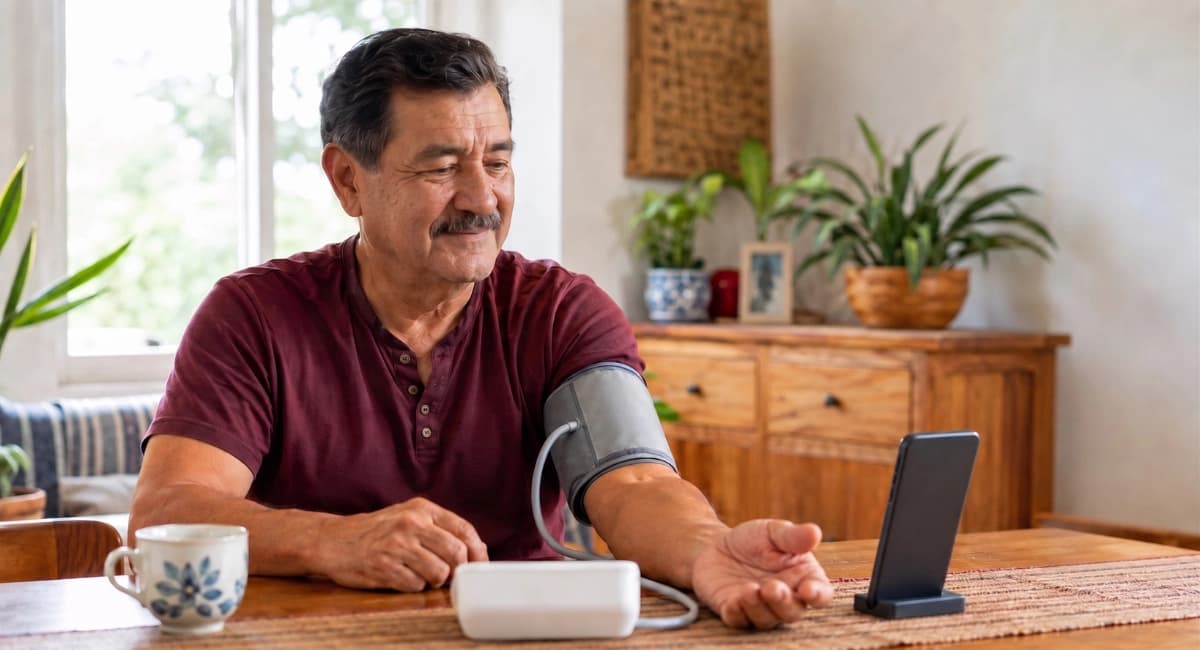
How Noctua Care changed their lives
What our participants say, in their own words.

“I learned to listen to my body instead of being afraid of it.”
Evelyne G.Heart attack, 2023 
“I had the app when I left the hospital. I wasn't alone with my questions anymore.”
Jean-LouisAcute coronary syndrome 
“115 pounds down over two years, and I quit smoking. I started with a ten-minute walk.”
Franck G.Patient since 2022
Foundations
Build on leading cardiology guidelines
We combine prevention recommendations, clinical guidelines, and practice evidence
AHA/ACC secondary prevention guidance
The program follows published American Heart Association and American College of Cardiology guidance on secondary prevention: lipid control, blood pressure, physical activity, smoking cessation and adherence.
Reviewed by hospital cardiologists
Every module was written and then reviewed by practicing cardiologists. The board is named on the evidence page.
Built in Europe, deployed in the US
The program has been running in France since 2024. The US deployment carries the same clinical content under US guideline references.
- 1Regulatory status. Noctua Care is a wellness and care management program. Monitoring devices used are FDA-cleared.
- 2Evidence. Engagement. DiSuACS, Health Data Hub registration 30001700, single-arm feasibility study, CHU Bordeaux, 2026. n=30, 30-day observation.
- 3PCM code assignment. 99424 and 99425 are the physician or QHP codes; 99426 and 99427 are the clinical staff codes.
Interested in the program?
Thirty minutes with our clinical team. We'll show you the patient app and model the program against your own panel.